Monday, September 16, 2013

It's Monday - Time for Another Mystery Artifact!

I actually had another artifact in mind for today's post, but in searching the collections to find it, I came across something so much more fascinating that I had to post it instead!  Here it is:


Because of the object's size, I have posted a close-up view of the items at the bottom:


Give it your best guess!  As always, respond on our Facebook page or in the comments below with your ideas as to this beautiful artifact's name and function!

Thursday, September 12, 2013

The Answer Lies Within...

This week's mystery artifact received a lot of guesses on so many different media! We heard from those who thought is was a woodworking tool, a nut pick for removing stubborn nutmeats, a spoon for snuff or cocaine and even a gunpowder loading spoon.  Thanks Penny, Jess and Jenn for your guesses!  Before I reveal the answer, let me just tell you that our Mystery Artifact this week is intimately connected to a little known substance called cerumen. No,that is not a character from Star Trek.   Cerumen is an antimicrobial substance naturally produced by your body. Guessed it yet? You might call these little instruments cerumen harvesters if you were so inclined. They are:

EAR SPOONS! (and cerumen is ear wax). Look inside the ear to see where ear wax is stored.


Man, with a glob of ear wax like that I think you might want to harvest it.

Thanks Penny and Jenn for your correct guesses. (And thanks Penny for your comment, ICK!).

Ears build up cerumen to protect themselves from fungi, bacteria, insects and even your dirty fingers! All the best advice (today) is to NOT PUT ANYTHING IN YOUR EARS.

Why would you want ear wax so badly? Well, medieval illuminators used their ear wax added to the gesso to make the right consistency for their gold paint!


And frugal housewives of the 19th century (I kid you not) said ear wax was a great salve for puncture wounds and --get this--for chapped lips!  Women also used ear wax to wax their thread to make it glide more smoothly through the needle's eye and the fabric which they sewed.


If you haven't read the Frugal Housewife, now is the time to start! There are all kinds of amazing tips in here.

Finally, be happy be happy that your earwax comes out!  Whales never get rid of their ear wax and sometimes it's the only reliable way to tell the age of a whale (by how much he/she has!).  Yikes, that is a lot of ear wax. Wonder how big that ear wax spoon would have to be? 


OK. Happy Readers. That's it for this week's Mystery Artifact. Stay tuned. More soon.


ADDENDUM:

OH MY GOSH. Two posts today made us think of last week's mystery artifact.:

First an article on NPR about whale ear wax


and this on how to clean out your ears from one of our favorite blogs, Ask the Past.


Friday, September 6, 2013

Is it September already?

Oh, dear readers, here it is September 6 and we haven't posted a Mystery Artifact in over a week! Fear not, we have plenty of mysterious things in the collection yet to discover. In fact, this time I'm posting a whole class of artifacts. Tell me what you think these little numbers do!


You can comment here, on Facebook, or on Twitter! It's all the same to us. We'll respond however you like.
Have a wonderful weekend guessing.


Tuesday, August 27, 2013

Another Hot Artifact Revealed!


We had lots of great guesses for our latest mystery artifact, including a fantastic guess working out exactly how it could be used as a prototype for a modern glue gun!  However, penny6612 was exactly right when she guessed it was the heater for a curling iron.  While it might not have worked well for the enormously long curling iron we had as mystery artifact last week, it would be just right for this later design:


As you can see in this add from the 1895 Montgomery Ward catalogue, there were several different types of curling iron heaters available on the market in the late 19th-century (although as the quote from Little Town on the Prairie showed last week, one could always heat curlers on the stove in a pinch!)


I find the descriptions of these heater fascinating, especially the multiple uses of the Peerless Lamp Chimney Stove ("To heat curling iron use as shown on this cut.  To heat cup of water, remove loose top and all the heat of the lamp will come in direct contact with bottom of cup").  I also find the claims that both items can be folded and closed so each might be "carried in the pocket" quite intriguing; was on-the-go hair curling and styling a real need in the 1890s?


We hope you are enjoying the weekly mystery artifact posts.  We are certainly having fun trying to stump our co-workers by finding artifacts with functions that are quite a challenge to guess!  Make sure to check back over the next few days as our illustrious Director will be choosing the next mystery artifact!


Friday, August 23, 2013

Mystery Artifact #11!


Hello, all.  What a busy few weeks it's been, with most local districts and colleges going back to school!  In an effort to get your brain-power kickstarted in time for the fall semester, here is a new mystery artifact for you to ponder:


I even remembered to include a penny for scale this time around! 

You guys know the drill by now - post questions, comments, and guesses in the comments section of the blog or on our Facebook page.  Happy guessing!

Monday, August 19, 2013

Mystery Artifact Revealed!


We had some terrific guesses for last week's mystery artifact, which was (drumroll, please) . . . a curling iron!  We actually have several curling irons in our collection, although the one pictured above is probably the oldest (we're guessing  it dates to circa 1800).  It's definitely the longest of the bunch, as well, measuring just under 18 inches in length!

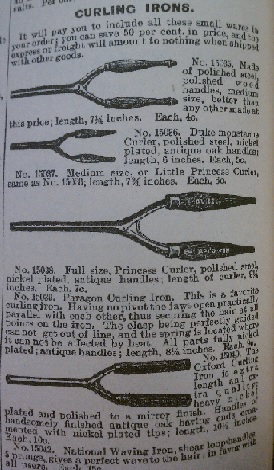
Although we may tend to think of curling irons as a modern item, they are featured prominently in catalogs from the 19th Century.  They were not an item marketed specifically for females, as the second curling iron in the advertisement from the 1897 Sears Roebuck catalog pictured below is described as a "Duke moustache Curler . . . Each 5c(ents)."


The photo below shows a different curling iron from our collection, one of many that are similar to the ones pictured above:  


As this advertisement from the 1895 Montgomery Ward catalog shows, women took their curls very seriously -- at times opting to purchase pin-on bangs rather than take the time and trouble to self-style their hair!


The text for the  La Toska Bang pictured above reads:  "Ladies who do not require large, heavy front will find this a little gem; light and fluffy, ventilated foundation.  Each, until sold $1.25."  A fabulous description, although I have to confess, as a brunette, I take offense to the description of hair colors as red, gray, golden, and "drab" . . . "in switches, waves, bangs, etc."  There were, however, several shades to choose from, and customers were instructed to "send samples of hair . . . (in) shade wanted, free from oil, folded up in a paper, pinned to your order and marked 'Sample,' to avoid any mistake."

Lest we assume that women were the only customers for false hairpieces, take note of the advertisement below for "Full Beards," "on wire" for $1.00 or "ventilated" for $2.00!  The catalog also offers "mustache on wire spring, common" at 10 cents each or a dozen for 75 cents; "mustache, ventilated" for 20 cents; "imperials"; "goatees"; and "whiskers, side . . . each .75 (cents)."


As historians, archaeologists, and students of material culture, we can learn quite a bit from catalog advertisements regarding items of personal adornment and various presentations of the body.  However, first-hand accounts can also tell us how people lived their lives, including how they utilized common objects when 'boughten' items were unavailable.  In her book Little Town on the Prairie, Laura Ingalls Wilder (whose hair was a "pretty brown" and not "drab," thank you very much!) described begging her mother and father to be allowed to wear a bang, or "fringe."  Having been given permission, she used Ma's sewing shears to cut "a narrow fringe about two inches long" which she then curled using a slate pencil:

"She laid her long slate pencil on the heater, and when it was heated she held it by the cool end and wound wisps of the short hair around the heated end.  Holding each wisp tightly around the pencil, she curled all the bangs."


Tuesday, August 13, 2013

Mystery Artifact #10

Hello, all!  Valerie here!  As we near the end of summer and the start of the school year, we are on to our tenth mystery artifact (by my count.  Please let me know in the comments if I've missed one).  Last week's artifact proved especially tricky, although we had some very well-reasoned guesses.  I've tried to choose one that might be a bit easier this week.  Here is the photo:


This object is about 18" long (I will try to remember to add a coin or ruler for scale next time!), and as you can see it is very slender.  I've added a second photo from another angle:


You guys know the drill by now--post your comments in the section below or on our Facebook page!  Can't wait to hear from you!